
Chimney Flashing Repair in Greater New York, NY — Same-Day Inspections Starting at $275
Chimney flashing repair in Greater New York typically runs $275–$850 depending on whether you’re addressing surface sealant failure or replacing embedded counter-flashing in aged masonry. Most jobs we diagnose in the morning are wrapped by afternoon. Call (866) 884-9512 for a free inspection — Robert Garcia, our owner and lead technician, handles every assessment personally.
Last April, a homeowner in Astoria called us after their ceiling above the fireplace collapsed into the living room. Two different roofers had “fixed” the leak in eighteen months. Both times, they caulked the step flashing along the roof plane and called it done. Nobody had checked the counter-flashing cut into the chimney’s mortar joints — the actual failure point. The water had been running behind the brick for three winters, rotting the wall framing and saturating the plaster lathe until it let go. That’s a $275 flashing repair that became a $14,000 interior reconstruction. We see this story repeat across Queens brownstones, Bronx row houses, and Brooklyn walk-ups every spring.
Why Roofers Keep Missing the Real Problem
Chimney flashing is two separate systems installed by two different trades, and that split ownership is exactly why it fails so predictably in Greater New York homes.
Step flashing (also called base flashing) lives on the roof. It’s the L-shaped metal pieces woven into each shingle course where the roof meets the chimney. Roofers install this. When it corrodes or pulls free, water enters at the roof plane — and competent roofers catch it.
Counter-flashing is embedded into the chimney masonry itself. It’s the metal cap that folds down over the step flashing, directing water out and away from the joint. This is chimney work, not roofing work. It requires cutting a reglet — a horizontal chase into the mortar joint — bending the metal into that slot, and sealing it with lead wedges or polyurethane sealant.
Here’s where Greater New York’s housing stock makes this worse: our brownstones, row houses, and pre-war apartment buildings often have modified bitumen or built-up roofs with minimal pitch, terminated at rear chimneys that haven’t been properly touched since a 1960s or 1970s re-roofing. The original counter-flashing was frequently surface-applied — caulked or tarred to the brick face rather than embedded. That caulking has a 5–7 year lifespan in our freeze-thaw climate. When it cracks, water doesn’t leak through the roof. It leaks behind the counter-flashing, runs down the chimney face inside the wall cavity, and appears as mysterious stains on interior plaster — often feet away from the actual chimney breast.
Roofers see water, patch the step flashing, and leave. The counter-flashing keeps failing. The homeowner calls another roofer. The cycle continues until someone who understands chimney masonry gets involved.
That’s why Robert Garcia insists on handling both sides of this joint. When Apex Chimney Cleaning Greater New York repairs your flashing, we cut the reglet, embed the counter-flashing properly, and coordinate with your roofer only if the step flashing itself needs replacement. No finger-pointing. No repeat leaks.
The Reglet Method: Why Embedded Counter-Flashing Survives New York Winters
Surface-applied counter-flashing — the kind you see held on with beads of caulk or roofing cement — is everywhere in Greater New York because it’s fast and cheap. It’s also temporary. Our climate cycles from 5°F to 55°F and back within a single winter week. That thermal movement cracks caulk, separates tar, and creates capillary paths for water.
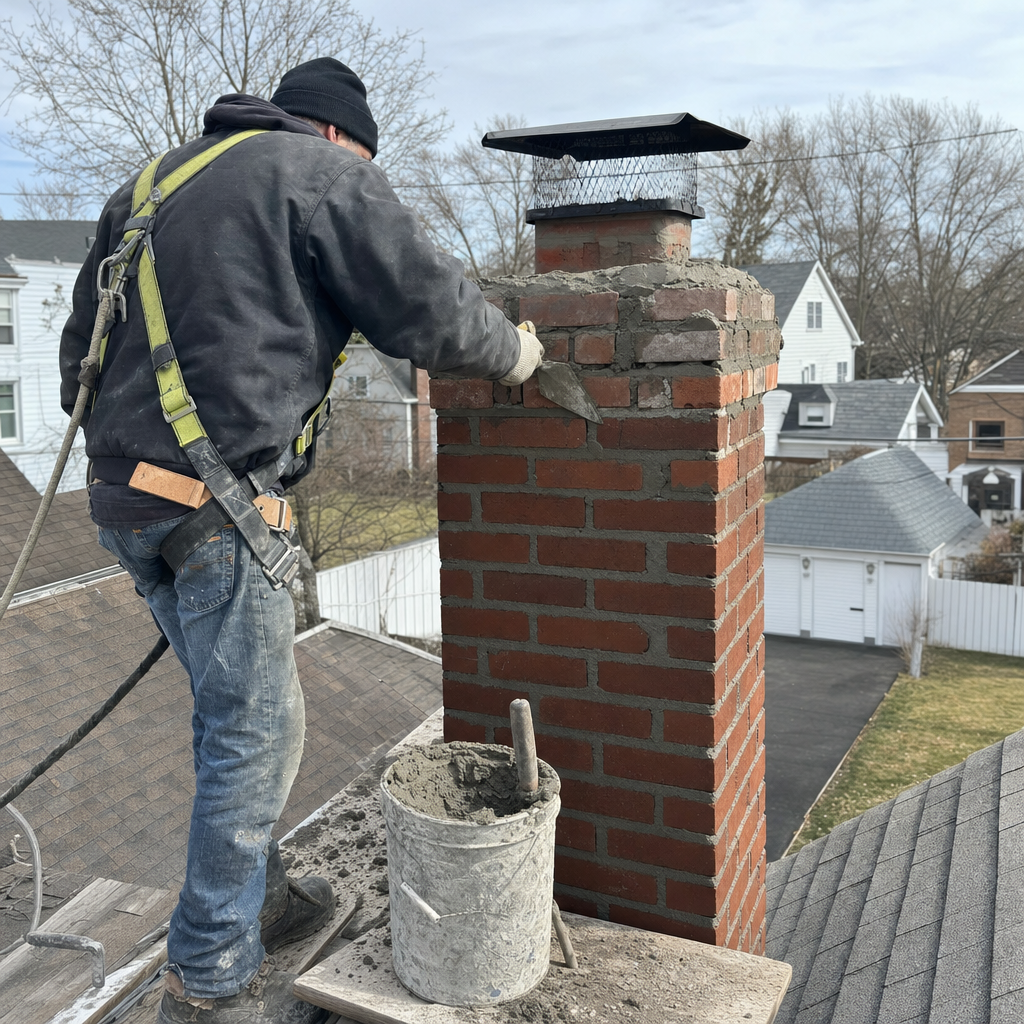
The reglet cut-in method is different. We grind or chase a ¾-inch to 1-inch horizontal slot into the mortar joint, typically one course above where the roof meets the chimney. The counter-flashing metal — usually 16-ounce copper or 26-gauge galvanized steel — gets bent into an L-shape, inserted into that slot, and secured with lead wedges or stainless steel expansion anchors. The joint is then pointed with matching mortar or a flexible polyurethane sealant rated for masonry movement.
This creates a mechanical bond, not an adhesive one. The metal can’t pull away because it’s physically locked into the masonry. In freeze-thaw cycling, the mortar joint and metal move together rather than shearing apart.
We’ve pulled out surface-applied counter-flashing in Park Slope and Maspeth that was “repaired” three times in eight years. The embedded reglet work we did in its place? Still dry after a decade. That’s the difference between a chimney specialist and a handyman with a caulk gun.
Materials matter too. Where the job calls for sealants compatible with our reglet work, we specify products from HeatShield and Gelco — the same professional-grade lines we use in our full liner and crown rebuilds. These aren’t hardware-store caulks. They’re formulated for the thermal stress and UV exposure that New York rooftops see.
What Chimney Flashing Repair Costs in Greater New York
Pricing depends on accessibility, masonry condition, and whether we’re resealing an existing reglet or cutting new embedding. Below are the ranges we quote for Greater New York properties — from walk-up Brooklyn row houses to multi-story Bronx apartment buildings with roof access constraints.
| Service | Price Range |
|---|---|
| Sealant replacement / spot reglet repair (1–2 sides) | $275 – $450 |
| Full counter-flashing replacement, reglet cut-in (standard chimney) | $550 – $850 |
| Chimney with severe mortar deterioration requiring repointing first | $850 – $1,400 |
| Multi-flue or commercial chimney with extended perimeter | $1,200 – $2,200 |
| Interior water damage assessment (if staining is present) | $0 – $150 (waived with repair) |
These figures assume standard roof access. If your building requires scaffolding, boom lift, or specialized rigging — common in Manhattan and parts of Jersey City with height or setback restrictions — we’ll note that during our free inspection and price it upfront. No surprises.
Context matters for the decision. Unrepaired flashing failure in a Greater New York home typically reaches wall framing and interior plaster within 2–3 heating seasons. Median interior water damage remediation in our market runs $8,500–$15,000 once mold, plaster replacement, and framing repair are factored. A $550–$850 flashing repair is a bounded, predictable investment against an unbounded liability.
Signs Your Flashing Has Already Failed
Not every leak announces itself with a ceiling collapse. In 17 years across the five boroughs, Robert Garcia has learned the early warnings that Greater New York homeowners often dismiss:
- Water stains on the ceiling or wall adjacent to the chimney breast — especially after rain rather than snowmelt, which suggests roof-plane failure instead
- Efflorescence (white powder) on interior chimney brick — mineral deposits left by evaporating water that’s already inside the masonry
- Damp or musty odors in the firebox during humid weather — water is pooling in the smoke chamber or damper area
- Spalling or flaking exterior brick below the roofline — freeze-thaw damage from water saturation, not age alone
- Loose or missing mortar joints near the roof intersection — the reglet seal has failed and water is eroding the bedding mortar
If you’re seeing any of these, the flashing has likely been compromised for at least one full season. A chimney problem doesn’t get smaller by waiting — we’ve seen 17 years of proof.
Why Apex Handles the Full Scope
The coordination failure Robert sees most often: homeowner calls roofer, roofer says chimney needs masonry work, homeowner calls mason, mason says roof needs work, both trades point at each other while the leak continues. We’ve been called into jobs in Bay Ridge and Washington Heights where this cycle ran for two years.
Apex Chimney Cleaning Greater New York eliminates that. We’re a Chimney Repair specialist with full masonry capability, not a sweep who outsources everything past a brush. Robert Garcia assesses the flashing, determines whether the failure is in the step flashing, counter-flashing, or both, and executes the chimney-side work directly. If your step flashing also needs replacement, we’ll show you exactly what needs to happen and coordinate with your roofer — or refer one we trust — with clear scope boundaries so there’s no overlap or gap.
This matters for warranty and accountability too. When one company touches both the masonry and the flashing interface, there’s no dispute about where the leak originated if something goes wrong. Our 1,096 verified reviews averaging 4.7 stars reflect that accountability. Customers know who to call, and they get the decision-maker on the phone or the roof.
We work with professional-grade materials throughout — Olympia Chimney components for cap and crown integration, Famco hardware where custom fabrication is needed — because the flashing system has to integrate with whatever’s above and below it. Patchwork materials from different suppliers fail at their interfaces. We spec for the full assembly, not just the visible repair.
What to Expect During Your Inspection
Robert Garcia conducts every flashing assessment personally. Here’s how a typical visit unfolds:
We start inside, documenting any interior staining or moisture damage with photos you’ll keep for insurance purposes if needed. Then we examine the exterior from roof level — checking step flashing condition, counter-flashing embedment, mortar joint integrity, and whether previous repairs were surface-applied or properly regleted. We’ll run a water test if the failure isn’t visually obvious: controlled spray at the chimney-roof intersection while an observer monitors inside.
You’ll get a written scope with line-item pricing before any work begins. Most standard repairs are completed same-day once approved. Larger jobs requiring mortar curing or custom metalwork are scheduled within 48 hours.
Our home page outlines our full service range, but flashing repair is one of the most urgent calls we take — precisely because the damage it causes is invisible until it’s expensive.
FAQs
Most residential chimney flashing repairs in Greater New York run $275–$850, with simple sealant work at the low end and full reglet cut-in replacement at the high end. Multi-flue or commercial chimneys, or those requiring scaffolding access, can reach $1,200–$2,200. Call (866) 884-9512 for a free inspection and exact quote — estimates are free.
Call a chimney specialist first if the leak appears on interior walls or ceilings near the chimney breast, especially if previous roof repairs didn’t solve it. Counter-flashing embedded in chimney masonry is chimney work, not roofing work, and roofers often lack the masonry tools or expertise to address it properly. Apex Chimney Cleaning Greater New York assesses both the roof-side and chimney-side flashing to identify the actual failure point.
Standard counter-flashing repairs are typically completed in 3–5 hours and often wrapped same-day after morning inspection. Jobs requiring mortar repointing or curing may need a return visit within 24–48 hours. We’ll give you a clear timeline during your free estimate — no open-ended scheduling.
Repair is cheaper when the metal itself is sound and only the sealant or embedment has failed — typically $275–$450. Replacement becomes necessary when the metal is corroded, improperly surface-applied, or the mortar joint has deteriorated beyond resealing. In those cases, cutting a new reglet and installing fresh counter-flashing ($550–$850) prevents the repeat repair cycle that costs more over time. Call (866) 884-9512 and we’ll tell you honestly which category you’re in.
Stop the Leak Before It Reaches Your Framing
If you’ve got water stains, musty odors, or a history of “fixed” leaks that keep coming back, the counter-flashing is the likely culprit — and it’s not going to seal itself. Apex Chimney Cleaning Greater New York offers free inspections with Robert Garcia, our owner and lead technician, and same-day repair on most standard jobs. Call (866) 884-9512 now. We’ll find the real entry point, quote it upfront, and handle the chimney-side work so you’re not coordinating trades while your walls soak.
Written by Robert Garcia, Owner & Lead Technician at Apex Chimney Cleaning Greater New York, serving Greater New York, NY.