
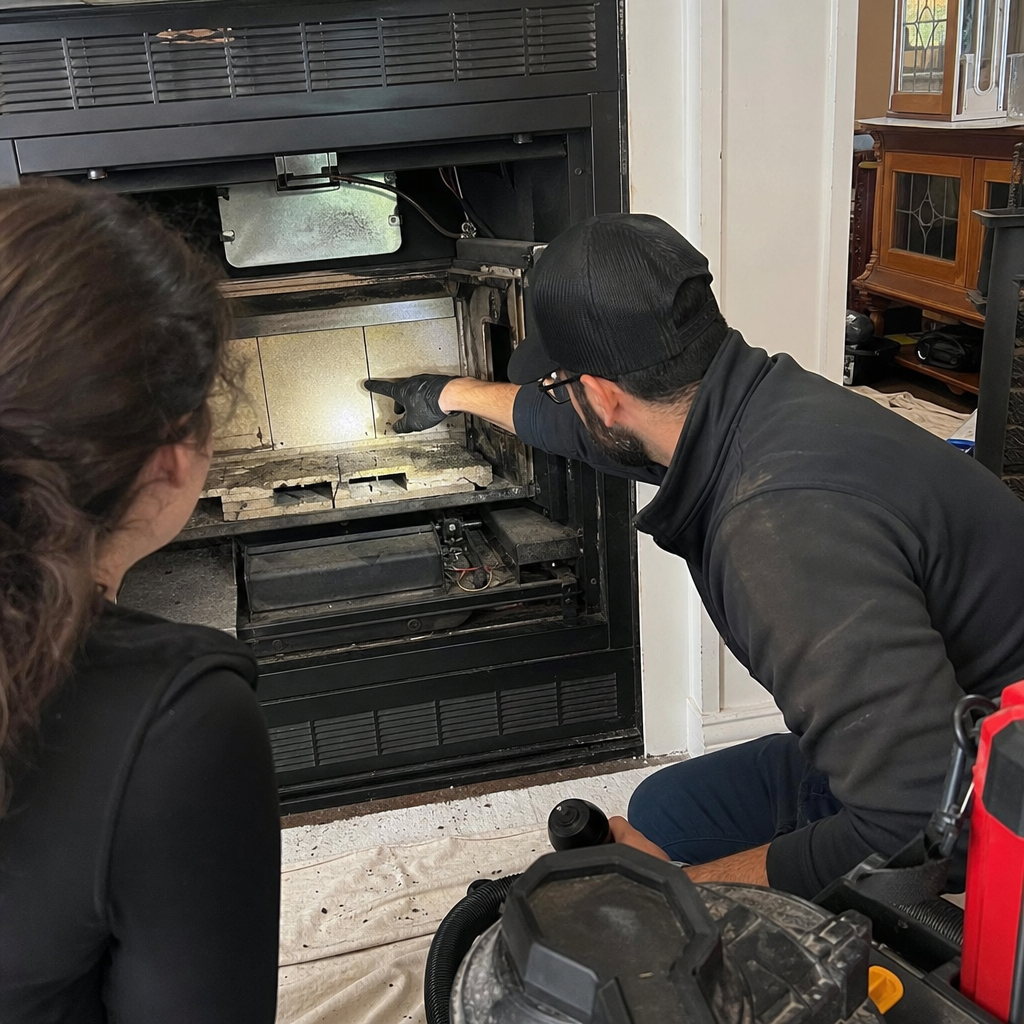
What Is Creosote Buildup? A Greater New York Homeowner’s Guide to the Three Stages Hiding in Your Flue
Creosote buildup is the accumulation of tar-like combustion byproducts that coat the inside of your chimney flue when wood or fossil fuels burn incompletely. In Greater New York’s older housing stock — from Bayside colonials to pre-war Bronx walk-ups — it forms in three chemically distinct stages, each with different physical properties, removal methods, and fire hazards. Stage 1 brushes out in minutes. Stage 3 can require chemical treatment and multiple visits. Confusing them is how a swept chimney still harbors a fire risk.
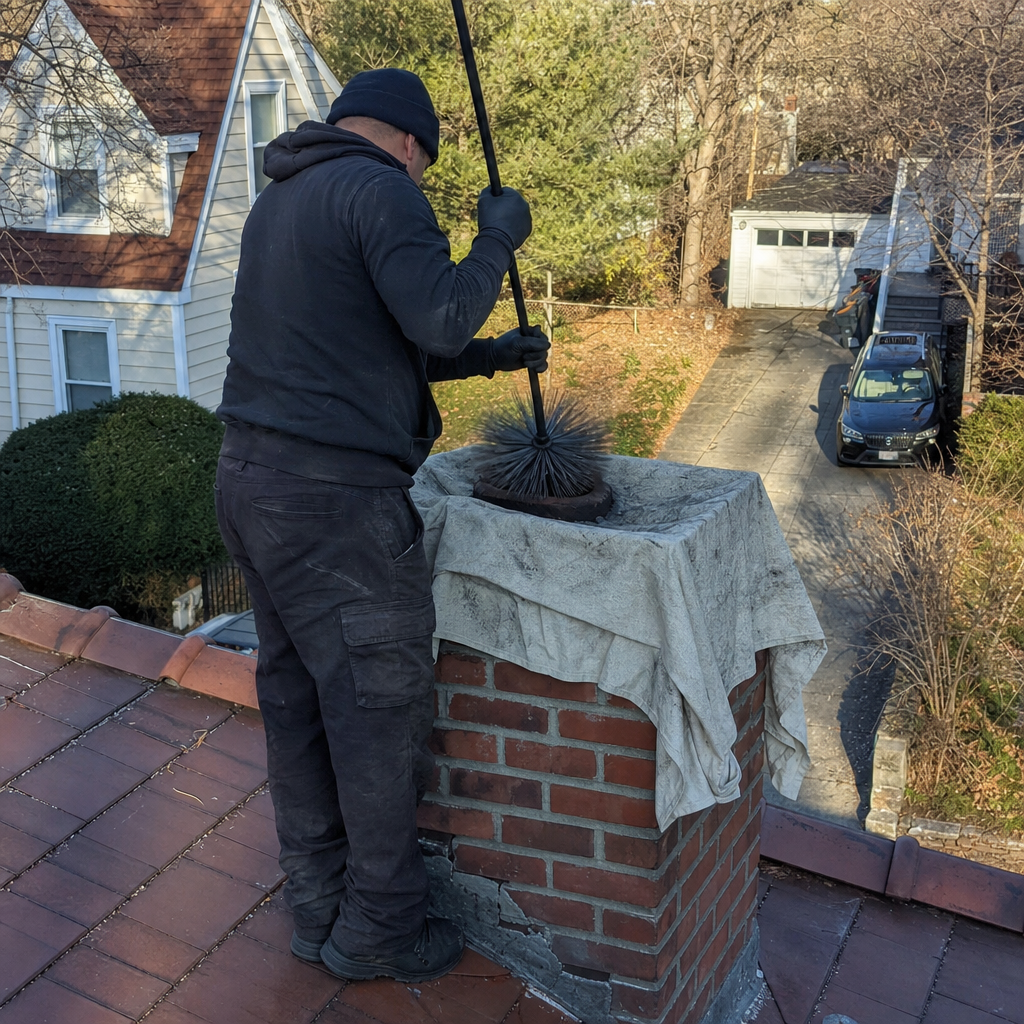
We’ve pulled all three from chimneys on the same block in Bayside during the same winter. Same neighborhood, same heating season, completely different problems. That’s why understanding what creosote actually is matters more than most homeowners realize.
If you’re noticing a strong, smoky odor when the fireplace isn’t running, or you’re due for your annual inspection, call Apex Chimney Cleaning Greater New York at (866) 884-9512. Robert handles the work himself, and estimates are free.
The Three Stages of Creosote: What You’re Actually Looking At
Most explanations treat creosote as a single substance to be removed. It isn’t. The stage determines the tool, the time, and the danger level.
Stage 1: Dry, Flaky Soot
This is the form every homeowner hopes to find. Stage 1 creosote is light-gray to black, dusty, and brittle — it brushes away with a standard chimney sweep brush in about twenty minutes. It forms when fires burn hot and dry, with seasoned hardwood and adequate airflow. We see this most often in well-maintained systems with straight flues and proper draft.
In Greater New York, Stage 1 is common in post-1980s construction with insulated flues and homeowners who burn kiln-dried hardwood. It’s the baseline we want to maintain through annual Chimney Cleaning & Sweep visits.
Stage 2: Shiny, Crunchy Black Layer
Stage 2 shifts texture dramatically. The surface becomes hard, shiny, and brittle — almost like obsidian flakes. It requires rotary tools, chains, or chemical treatment to remove. The formation chemistry is straightforward: incomplete combustion plus cooler flue temperatures equals more creosote. Cold outer walls on New York brownstones and poorly insulated flues in pre-war construction create exactly the lower-than-ideal temperatures that accelerate Stage 2 formation.
Robert once pulled a flue brush out of a Staten Island chimney mid-sweep and found it coated in what looked like amber glass — Stage 3 glazed creosote from a homeowner who’d been burning unseasoned pine for six winters. The brush survived. The flue tile did not. That same property had started as Stage 2 two years prior; the owner had skipped the recommended follow-up sweep.
Stage 3: Glazed, Tar-Like Deposit
This is the fire hazard that keeps us up at night. Stage 3 creosote is a glossy, hardened glaze — amber to deep black — chemically bonded to clay tile or stainless steel. It cannot be brushed out. It requires professional-grade chemical agents, often multiple applications, and sometimes two visits to fully dissolve and remove.
The danger isn’t just the material itself, which ignites at approximately 451°F. It’s that Stage 3 buildup restricts flue diameter, reducing draft and causing even cooler flue temperatures — which accelerates further creosote formation. It’s a self-reinforcing problem that turns a chimney into a slow-building fire risk.
We’ve encountered Stage 3 in:
- Homes where unseasoned softwood (pine, fir) has been burned regularly
- Properties with exterior chimneys on north-facing walls, common in Forest Hills and parts of the Bronx
- Systems with damaged or missing chimney caps allowing moisture intrusion
- Fireplaces converted to wood-burning inserts without proper liner resizing
Why Greater New York’s Housing Stock Makes This Worse
Our climate and architecture create specific conditions that accelerate creosote formation beyond what generic national advice accounts for.
Pre-war construction dominates. Much of Queens, the Bronx, and Brooklyn was built before 1940 with uninsulated masonry chimneys. These exterior walls stay cold — sometimes below the dew point even during active fires — creating the exact temperature differential that condenses volatile combustion products into liquid creosote before they can exit.
Brownstone shared walls. In Park Slope, Bed-Stuy, and similar neighborhoods, chimneys often run through party walls with minimal air gaps. The thermal mass of neighboring structures keeps flue temperatures marginal for hours after firing, extending the condensation window.
Seasonal moisture swings. Greater New York’s humid summers and freeze-thaw winters drive moisture into masonry. A damp flue liner doesn’t just smell musty in September — it requires more energy to reach proper operating temperature, extending the incomplete-combustion phase at every fire’s start.
Tight modern construction. Paradoxically, newer energy-efficient homes in developments like those spreading through eastern Queens can suffer negative pressure issues. Exhaust fans, range hoods, and tight envelopes compete with the chimney for makeup air, reducing draft and slowing flue gas velocity — more time for creosote to condense.
The Gas Fireplace Misconception
We hear this several times a month: “I have a gas fireplace, so I don’t need cleaning.”
Gas combustion does not produce creosote. But that statement misses what gas fireplaces do produce: water vapor in significant volume, and in older manually-converted appliances, residual oil soot from incomplete gas-air mixing. We’ve opened vented gas fireplaces in Flushing and found degraded ceramic logs shedding particles, deteriorated flex liners collapsing inward, and moisture damage to surrounding framing that the homeowner attributed to “just condensation.”
Annual inspection matters regardless of fuel type. The failure modes differ, but the consequence — blocked or compromised venting — produces the same carbon monoxide risk.
When Creosote Has Already Damaged the Flue: Real Treatment Options
Stage 2 buildup that has etched or damaged clay flue tile presents a specific decision point. The creosote isn’t the only problem anymore — the surface it adhered to has been compromised.
In these cases, we evaluate whether the tile damage is superficial or structural. For localized etching and minor spalling with otherwise sound tile, a HeatShield cerfractory resurfacing application addresses both remaining creosote bonding sites and tile degradation simultaneously. The product fills minor cracks and restores a smooth, heat-resistant surface that resists future creosote adhesion.
When tile is cracked through, shifted, or significantly spalled — common in chimneys that have experienced chimney fires the owner didn’t recognize — full relining with a stainless steel system becomes necessary. We typically work with DuraFlex or Olympia Chimney liners for these applications, sized precisely to the appliance and installed to NFPA 211 standards.
The key distinction: HeatShield treats surface damage on sound tile. It doesn’t replace structural liner failure. Robert makes that call on-site after camera inspection, not from a desk.
Common Local Scenarios We See Every Heating Season
These aren’t hypotheticals. They’re the actual conditions Robert encounters across the five boroughs and surrounding counties.
The “We Just Moved In” Surprise
New homeowners in Astoria or Jackson Heights buy a 1920s rowhouse, light the first fire of December, and smell something acrid. Inspection reveals Stage 2 or 3 buildup from years of previous owners burning whatever was cheapest, with a deteriorated Famco cap that let rain in for three seasons. The sweep takes twice as long as estimated, and we recommend liner evaluation.
The Overconfident Seasoned Burner
Customer in Riverdale has burned wood for thirty years, “never had a problem.” But they’ve been burning the same standing-dead oak from a property upstate, never split or seasoned below 25% moisture. The flue brush hits Stage 2 at the smoke shelf every single time. They don’t believe us until we show them the camera footage.
The Insert Conversion Gone Quiet
1970s fireplace converted to a wood-burning insert in the 1990s, with the original clay liner never resized. The smaller appliance outlet dumps cooler, slower gases into an oversized flue. Stage 3 glaze builds at the liner’s reduced diameter section — exactly where inspection cameras struggle to see without proper equipment. We’ve found this pattern repeatedly in split-level homes across Nassau County.
The “It Was Swept Last Year” Disappointment
Homeowner shows a receipt from a cut-rate sweep who spent forty minutes on the roof. But the work was a top-down brush pass with no rotary tools, no chemical treatment, and no camera inspection. Stage 2 buildup remains, now another year harder. We quote the proper removal, and the customer realizes the previous “sweep” was performance theater.
What Professional Creosote Removal Actually Involves
Stage 1 removal is straightforward: protective containment, HEPA-filtered vacuums, mechanical brushing, and camera verification. Most Greater New York homes with annual maintenance never progress beyond this.
Stage 2 requires more: rotary cleaning systems with flexible drive shafts and specialized whips or chains, often with chemical pretreatment to soften deposits. We schedule these for mornings when the flue is cool but ambient temperatures allow chemical activation.
Stage 3 is the most involved. We apply professional-grade creosote modifier — not the consumer sprays sold at hardware stores — that chemically alters the glaze’s structure over 24-48 hours. Return visit involves rotary removal and detailed camera inspection. Severe cases may require a second chemical cycle.
| Stage | Appearance | Removal Method | Typical Time |
|---|---|---|---|
| Stage 1 | Dry, flaky, light-gray to black | Standard brush sweep | 45-60 minutes |
| Stage 2 | Shiny, hard, brittle black | Rotary tools + chemical pretreatment | 2-3 hours |
| Stage 3 | Glazed, amber to black, tar-like | Chemical modifier + rotary + return visit | Two visits, 3-4 hours total |
These timeframes assume standard single-flue residential systems. Complex configurations — multiple bends, unlined chimneys, or significant height — extend accordingly.
Prevention: What Actually Works in Greater New York
The fundamentals don’t change, but local conditions require specific attention.
Burn only seasoned hardwood. Oak, maple, ash — split, stacked, and dried below 20% moisture for at least twelve months. We keep a moisture meter on the truck and show customers their wood’s reading. Unseasoned pine isn’t just suboptimal; in a marginal flue, it’s dangerous.
Maintain active, hot fires. Smoldering loads for “all-night” burns are creosote factories. Build smaller, hotter fires with adequate air supply, and let them burn through completely.
Address chimney cap and crown condition. Water intrusion from missing or damaged caps — we install Gelco and Copperfield stainless systems — accelerates liner degradation and complicates every subsequent sweep. A Famco cap with proper screening keeps moisture and wildlife out while maintaining draft.
Schedule annual inspection before heating season. Not when you smell something. Not after the first fire. September and October appointments in Greater New York book fastest for a reason — the prepared homeowners know that a chimney problem doesn’t get smaller by waiting. We’ve seen 17 years of proof.
FAQs
Stage 1 chimney sweeping typically runs $200–$300 for a standard flue in Greater New York, while Stage 2 removal with rotary tools ranges $350–$550, and Stage 3 glazed creosote treatment requiring chemical modification and return visits generally costs $600–$900. The exact price depends on flue height, accessibility, liner material, and whether camera inspection reveals additional damage. Call (866) 884-9512 for a free estimate — Robert assesses in person and quotes before starting work.
Stage 1 buildup can be reduced with proper burning practices and consumer-grade creosote logs, but complete removal requires professional equipment and camera verification that no residue remains. Stage 2 and Stage 3 buildup should never be addressed by homeowners — the hardened and glazed deposits require rotary tools and chemical agents that demand training to use safely, and improper removal can damage clay tile or stainless liners. More critically, without camera inspection, you cannot confirm the flue is actually clear. We’ve been called after DIY attempts that left dangerous deposits intact.
The National Fire Protection Association recommends annual inspection for all chimney systems regardless of use frequency, and in Greater New York’s climate we strongly agree — freeze-thaw cycles, humid summers, and heating-season condensation create year-round deterioration even in rarely-used fireplaces. For primary heat sources or frequent recreational burning, annual sweeping is the minimum. We’ve found Stage 2 buildup in chimneys swept just eighteen months prior when the homeowner switched to unseasoned wood or experienced cap failure.
Gas fireplaces do not produce creosote, but they absolutely require annual inspection for other venting hazards including water vapor damage, degraded flex liners, blocked terminals, and carbon monoxide risks from incomplete combustion. The “no creosote, no problem” assumption has led to preventable incidents. We inspect vented gas systems for proper draft, liner integrity, and appliance connection security — the failure modes differ from wood, but the consequences of neglected maintenance do not.
When to Call a Professional
If you smell smoke when the fireplace isn’t running, notice black material falling into the firebox, see shiny deposits on visible flue sections, or simply don’t know when your chimney was last properly inspected, it’s time. Creosote identification by stage requires visual assessment — photographs and descriptions help, but they don’t replace a camera inspection by someone who knows what they’re seeing.
Apex Chimney Cleaning Greater New York has completed more than a thousand documented customer outcomes across 17 years of chimney-only focus. Robert Garcia, the owner, serves as lead technician on every job. Customers get the decision-maker on-site, not a subcontractor learning the trade. Our 1,096 verified reviews averaging 4.7 stars reflect that accountability.
If you’d rather have it looked at, Apex Chimney Cleaning Greater New York offers a no-pressure assessment in Greater New York — call (866) 884-9512.
Written by Robert Garcia, Owner & Lead Technician at Apex Chimney Cleaning Greater New York, serving Greater New York, NY.