
DuraFlex Chimney Cleaning in Great Kills, NY | Apex Chimney Cleaning Greater New York
DuraFlex chimney cleaning and liner service in Great Kills typically runs $280–$520 for a full Level 2 inspection with creosote removal, and most appointments are completed same-day. We’re an independent DuraFlex service provider—not manufacturer-authorized—so we source genuine 316Ti and 904L components through our distributor network and match them to the salt-air conditions that destroy aftermarket liners here. Robert Garcia, our owner and lead technician, handles every Great Kills job personally. Call (866) 884-9512 for a free estimate.
Why Great Kills Residents Choose Us for DuraFlex Service
Robert Garcia grew up not far from Yankee Stadium in the Bronx, apprenticed under a veteran sweep who drilled into him that a clean flue isn’t a luxury—it’s what keeps a family safe through a New York winter—and has spent 17 years since crawling into chimneys across the five boroughs. He runs every Apex job himself or alongside his small crew. That matters in Great Kills, where the chimneys carry specific scars from Superstorm Sandy and decades of harbor exposure that a rotating subcontractor crew simply won’t recognize.
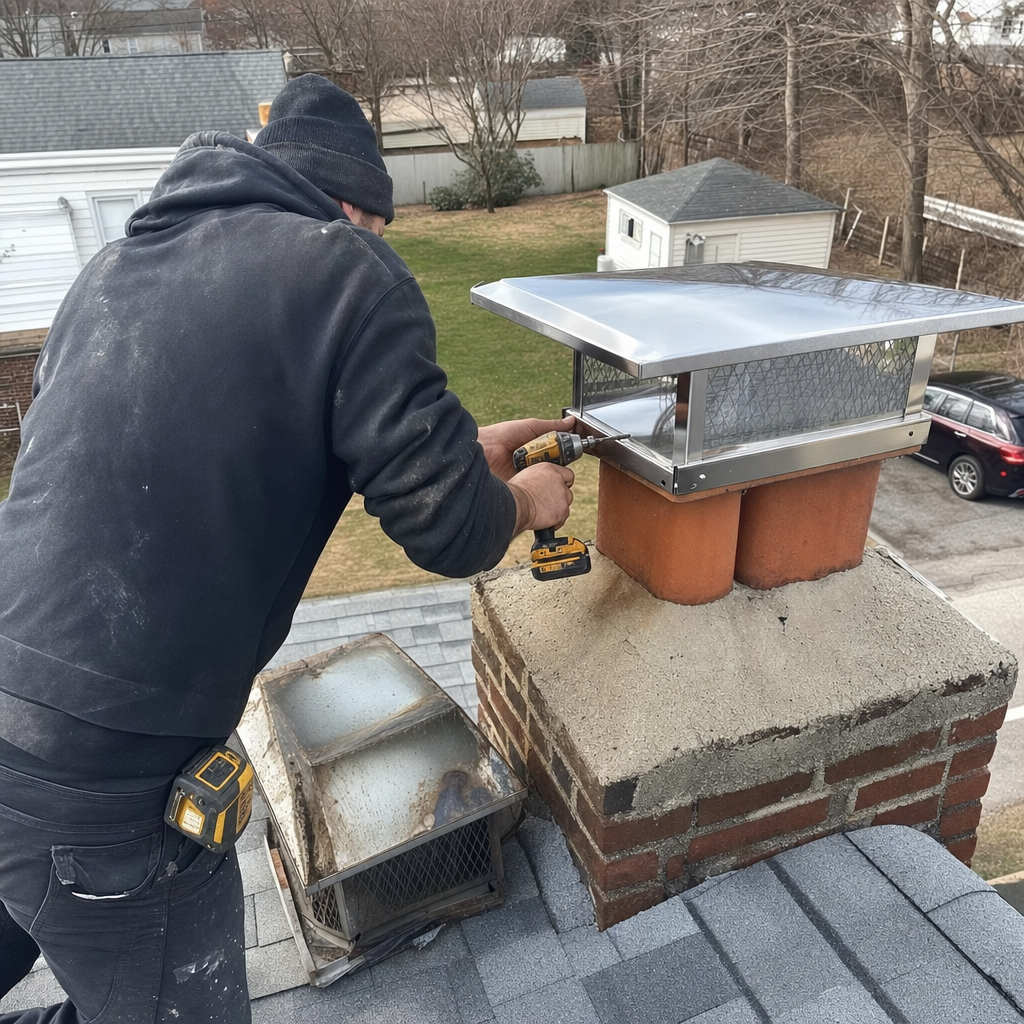
We’ve logged over 200 hours of hands-on training with DuraFlex’s 316Ti and 904L oval kits at our Great Kills staging facility. We carry offset adapters and top-plate hardware sized for the island’s flue geometries—parts we pre-assemble before rolling up to any south-shore block. Our 1,096 verified reviews average 4.7 stars, and they reflect what happens when the same person who quotes the job also climbs the ladder.
From routine sweep to full rebuild, we handle it. Professional-grade materials, installed right.
Common DuraFlex Chimney Cleaning Problems We Solve in Great Kills
- Salt-air pitting on 316Ti liners in harbor-adjacent homes. Chloride aerosols off Lower New York Bay attack the passive oxide layer on standard 316Ti stainless. Within 4–5 years, pin-size rust spots appear on liners facing the harbor. We catch this during Level 2 camera inspection and upgrade to 904L where the exposure is severe.
- Bottom-up corrosion from post-Sandy groundwater wicking. In elevated homes near Hylan Boulevard, salt-moisture drawn into the brick base corrodes the liner’s lowest 2 feet. The damage hides below the smoke chamber until perforation occurs. We inspect from the bottom up, not just the crown down.
- Kinking at the ‘dogleg’ offset in 1950s ranch homes off Amboy Road. Great Kills’s clay tile meets brick at a tight angle in these postwar builds. Our camera inspections routinely find 316Ti corrugation split at the bend from installation stress—often the original installer forced the liner rather than using a proper oval-to-round adapter.
- Creosote glazing from oversized flues on converted oil-to-gas systems. The 10308 corridor’s Cape Cods and ranches kept their original 8×13 clay tiles after conversion. The resulting cold flue gas condenses tarry creosote that standard brushes won’t touch. We use rotary polypropylene chains and chemical modifiers specific to glazed creosote in oversized flues.
- Crown fractures accelerating liner deterioration. Great Kills’s freeze-thaw cycles through wet, salt-saturated brick spall crowns at a rate noticeably higher than mid-island. Once the crown fails, water tracks down the flue wall and pools behind the liner, corroding the outer surface while the inner looks fine.
DuraFlex Service in Great Kills: What Local Conditions Mean for Your Equipment
Great Kills’s 1950s development by the Staten Island Home Builders Corporation used a single-contractor flue tile spec—8×13 clay tiles with a 2-inch offset at the roofline. Our crew pre-assembles custom DuraFlex oval-to-round adapters before arriving on any south-shore block, a step unnecessary in mid-island neighborhoods like Willowbrook. That spec shows up from Eltingville through Fresh Kills, and it means a “standard” liner kit off the shelf rarely fits without field modification.
The harbor-adjacent blocks along Milford Drive and Narrows Road North experience measurably higher moisture intrusion year-round. Nor’easters drive rain and salt spray directly into mortar cracks, and the freeze-thaw cycles attack crown integrity. For DuraFlex owners, this translates to a specific inspection rhythm: we recommend Level 2 camera scans every 18 months rather than the standard 24, because the local failure mode is hidden corrosion rather than obvious blockage. A chimney problem doesn’t get smaller by waiting—I’ve seen 17 years of proof.
DuraFlex Models & Products We Service in Great Kills
We work with four DuraFlex product families: the standard 316Ti for moderate-exposure installations, 904L for harbor-adjacent homes where chloride exposure is highest, the Oval 13×6 kit designed specifically for the tight offset flues common in Grant City and Eltingville ranches, and DuraFlex HP (High Performance) for high-efficiency appliance venting where condensation is aggressive.
Our Great Kills staging facility stocks genuine DuraFlex components—offset adapters, top plates, and termination caps—not aftermarket equivalents that lack alloy certification for this environment. We source through Apex’s national distributor network, and Robert verifies alloy grade with a magnet and spark test on every delivery. Fast turnaround matters when a liner failure means no heat; we don’t wait on drop-shipping.
DuraFlex Service Pricing in Great Kills
| Service | Price Range |
|---|---|
| Level 2 Inspection with camera scan | $180–$260 |
| Creosote removal (standard sweep) | $150–$220 |
| Crown repair with elastomeric coating | $340–$580 |
| DuraFlex 316Ti liner section replacement | $1,200–$2,400 |
| Full DuraFlex 904L reline with adapters | $2,800–$4,500 |
What drives cost: flue height, access difficulty (steep pitches on south-shore ranches), whether the existing liner can be extracted or must be destroyed in place, and the degree of crown or smoke chamber repair needed before the new liner seats properly. Our free estimate includes a full camera inspection—no charge, no obligation. Call (866) 884-9512 to schedule; we’ll give you an exact figure after seeing what we’re working with.
Serving Great Kills, NY — Our Local Coverage Area
We’re based in the Great Kills area and know this community well. Use the map below to see our service coverage — if you’re nearby, we can almost certainly help.
FAQs — DuraFlex Chimney Cleaning in Great Kills
Not always, but probably. Gas inserts vent cooler, wetter exhaust that condenses in oversized clay flues—the exact setup in your 1955 build. Without a properly sized DuraFlex liner, you’ll get acidic condensate eating the mortar and chronic moisture problems. We camera-scan first to check tile condition; if they’re intact and the flue is properly sized, a connector liner may suffice. Call (866) 884-9512 and we’ll tell you exactly what you’ve got.
A 316Ti liner in harbor-adjacent Great Kills typically shows meaningful degradation in 12–15 years versus 18–22 years in sheltered inland neighborhoods. The 904L alloy extends that to 20+ years even with salt exposure. The difference is measurable: we’ve replaced 316Ti liners in homes near New Springville Park that failed at year 11, while identical installations in Hillside are still sound at year 19. Your specific block matters.
Those crystals are efflorescence—salts leaching from the masonry as water migrates through. They indicate water intrusion, not necessarily liner failure, but the two often travel together. In Great Kills, efflorescence frequently traces to a compromised crown or deteriorated mortar joints letting harbor-driven rain behind the liner. We check whether the liner itself is perforated or if the water is bypassing it entirely. Either way, the condition worsens; a Level 2 inspection will separate the causes. Call (866) 884-9512 for a free look.
Yes—liner replacement in New York City requires a Department of Buildings permit, and Great Kills falls under Staten Island borough jurisdiction. We handle permit filing as part of our reline service; Robert submits the application and schedules the required inspection. Most homeowners never touch the paperwork. The process typically adds 5–7 business days to the project timeline.
Possibly, but smoke intrusion more often signals a liner disconnect, crown leak washing debris into the flue, or negative pressure changes from weatherstripping or new exhaust fans. In Great Kills, we’ve also found post-Sandy “repaired” chimneys where the liner shifted during structural settling and pulled free at the thimble. Don’t operate the fireplace until it’s diagnosed—carbon monoxide risk is real. Call (866) 884-9512; we prioritize smoke-odor calls same-day.
Service Areas Near Great Kills
We run DuraFlex service throughout the south shore and across the bridge: Brooklyn neighborhoods from Flatbush to Kensington, Hempstead and Hillside in Nassau County, and Manhattan’s Gramercy Park for clients with weekend homes in both boroughs. Most Great Kills appointments are routed from our Staten Island staging facility, so response times stay short.
Book Your DuraFlex Service in Great Kills Today
Robert handles every DuraFlex inspection and cleaning personally. Same-day appointments are often available for smoke-odor or suspected liner failure calls. Call (866) 884-9512 for your free estimate—no obligation, and you’ll speak directly to the technician who’ll be on your roof.
Written by Robert Garcia, Owner at Apex Chimney Cleaning Greater New York, serving Great Kills and the five boroughs since 2007.