
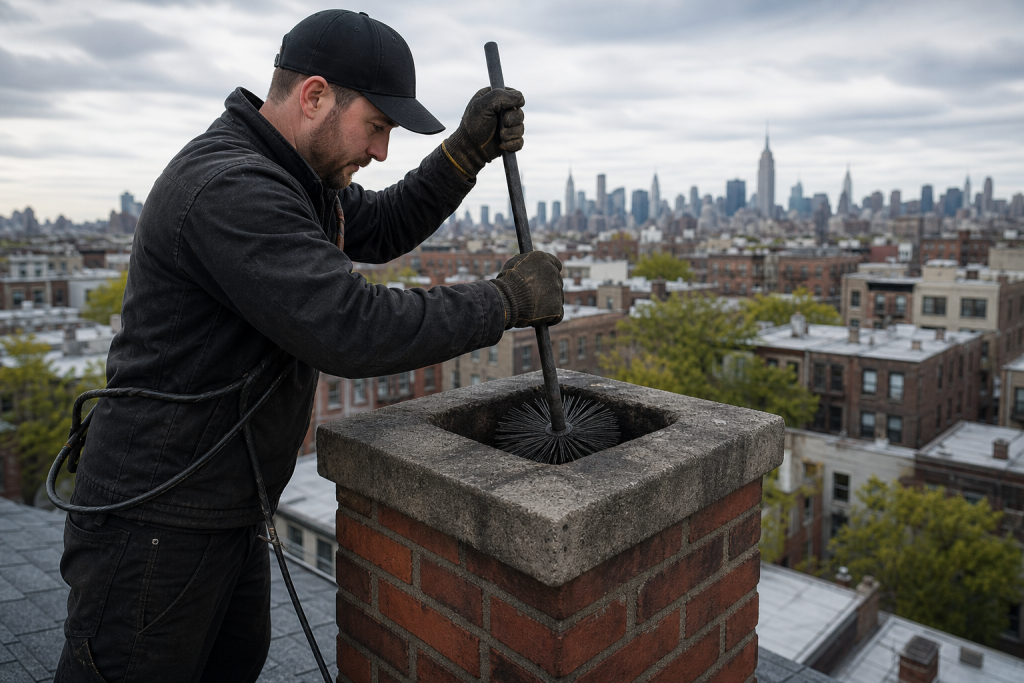
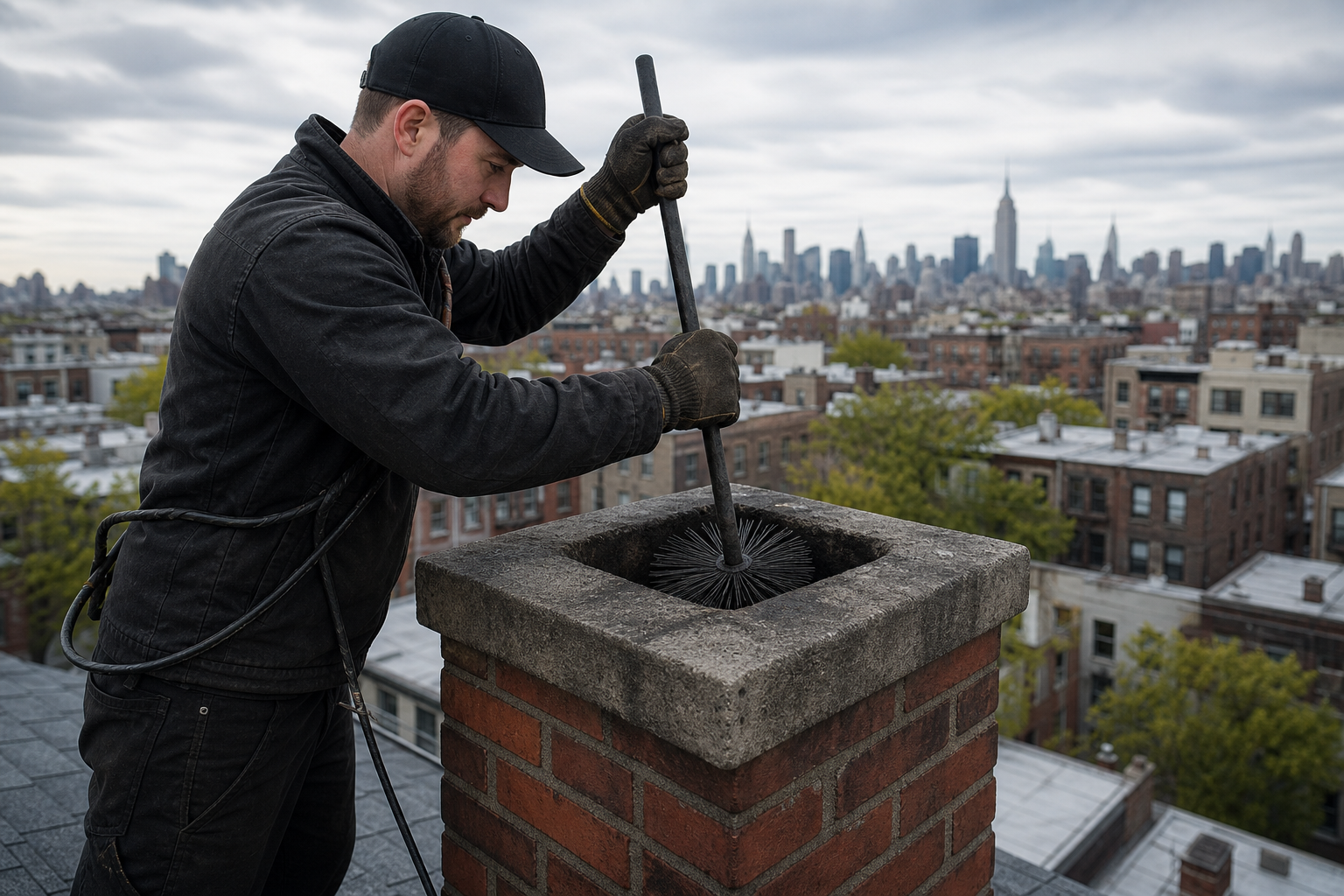
Emergency Chimney Cleaning & Sweep Near Me: What New York City Homeowners Should Do First
If you’re searching “emergency chimney cleaning & sweep near me” in New York City, first stop using the fireplace immediately, check for visible blockages or animal nesting from ground level, and call a certified chimney professional for same-day inspection — most emergency sweeps in the five boroughs run $200–$450 depending on accessibility and creosote buildup severity. In our 17 years of chimney-only work across New York City, we’ve found that the homeowners who act fastest on the warning signs — smoky rooms, falling debris, or a sudden bird chorus from the flue — avoid the costliest damage. If you’d rather not diagnose this yourself, call us at (866) 884-9512 for a free estimate; Robert handles emergency calls personally.
Here’s the mistake most New York City homeowners make: they assume a chimney emergency means visible flames or collapse. In reality, the emergencies we respond to most often start silently — a partially blocked flue in a pre-war brownstone in Brooklyn Heights, or a cracked liner hidden behind a decorative facade in a Washington Heights co-op. These conditions don’t announce themselves until smoke backs into the living room or carbon monoxide levels climb. The National Fire Protection Association reports that failure to clean chimneys is a leading contributor to home heating fires, yet in Manhattan’s dense housing stock, the bigger immediate risk is often ventilation failure in multi-unit buildings where one compromised flue affects several households.
How to Tell If Your Chimney Problem Is Actually an Emergency
Not every dirty chimney demands midnight service, but several conditions in New York City’s unique housing environment do. We’ve developed a simple triage framework from 1,096+ customer interactions across the five boroughs.
Call for same-day service if you observe:
- Smoke entering the room when the fireplace or heating appliance operates — this indicates a dangerous blockage or downdraft condition that can worsen rapidly in New York City’s wind-tunnel street corridors
- Visible creosote flakes or “chimney tar” dripping into the firebox; glazed creosote burns at approximately 2,000°F and is the leading cause of chimney fires in older masonry structures
- Animal sounds or nesting debris — squirrels, raccoons, and chimney swifts are common intruders in Queens and the Bronx, where tree canopy meets dense housing
- A strong, acrid odor during humid weather, which often signals saturated creosote or water intrusion compromising the flue liner
- White efflorescence or spalling brick on the exterior chimney face, indicating moisture penetration that accelerates freeze-thaw damage during New York City’s harsh winters
We inspected a chimney in Astoria last month where the homeowner had ignored “a little smoke” for three weeks. The flue was 70% blocked by a collapsed clay liner section and bird nesting — a carbon monoxide hazard in a building with six units sharing wall cavities. What felt manageable had become a building-wide safety issue. In New York City’s older housing stock, individual chimney problems rarely stay individual.
What to Do Immediately Before the Technician Arrives
While waiting for emergency chimney service in New York City, there are specific, safe steps homeowners can take — and critical ones to avoid.
Do this:
- Extinguish any active fire and do not start new ones; close the damper if accessible without reaching into the firebox
- Open windows near the fireplace to ventilate any smoke or fumes, particularly important in New York City’s compact apartments where air circulation is limited
- Check your carbon monoxide detector — if it’s alarming, evacuate and call 911 before calling us
- Photograph any visible damage from ground level: exterior cracks, displaced cap, or debris in the firebox; this helps us arrive with appropriate materials
- Clear a path to the fireplace and roof access if your building allows; New York City’s walk-up buildings and rooftop egress restrictions can add significant time to service calls
Never do this:
- Attempt to climb onto the roof yourself — New York City’s pitched roofs on brownstones and parapet walls on row houses present serious fall hazards, and emergency room visits outnumber successful DIY outcomes
- Use a household vacuum or brush to clear the flue — improper tools can damage clay liners or push obstructions deeper into offset flues common in pre-1940s construction
- Apply chemical “chimney cleaning” logs as a substitute for mechanical sweeping — these products loosen creosote but do not remove it, creating a false sense of security
Robert handles emergency diagnostics personally, and the information you provide by phone — building type, year of construction, and symptom timeline — lets us arrive with the right equipment for your specific New York City chimney configuration.
What Emergency Chimney Cleaning Costs in New York City
Pricing transparency matters in emergency situations. Here’s what we’ve observed across our 17 years of New York City service:
| Service | Typical Range | Factors Affecting Cost |
|---|---|---|
| Standard emergency sweep (single flue, accessible) | $200–$280 | Time of day, borough travel time, creosote stage (1–3) |
| Heavy creosote removal (stage 3 glazed) | $300–$450 | Chemical treatment required, multiple passes, protective equipment |
| Blockage removal (animal, debris, collapse) | $250–$400 | Camera inspection needed, debris disposal, liner damage assessment |
| Multi-flue system (common in pre-war buildings) | $350–$550 | Additional flues, offset construction, scaffolding or ladder work |
| After-hours/emergency premium | +25–40% | Weekends, holidays, severe weather response |
These ranges reflect actual New York City market conditions in 2024–2025. We’ve seen competitors quote $99 “emergency” specials that arrive as upsell operations with subcontracted crews. Our pricing is confirmed before work begins — Robert provides the estimate personally, and we carry the professional-grade materials (Olympia Chimney, Famco, Copperfield) to complete most repairs during the same visit rather than scheduling a return trip.
Related services in New York City: For non-emergency maintenance, see our Chimney Cleaning & Sweep in Hempstead page, or if inspection reveals structural issues, our Chimney Repair in Hempstead service.
Why New York City Chimneys Fail Differently Than Suburban Systems
New York City’s chimney emergencies follow distinct patterns shaped by local construction, climate, and regulation. Understanding these patterns helps homeowners recognize risk earlier.
Building age and type concentration: Manhattan below 96th Street and brownstone Brooklyn contain thousands of masonry chimneys built 80–150 years ago with unlined or clay-tile-lined flues. These systems weren’t designed for modern gas inserts or high-efficiency appliances, creating temperature mismatches that accelerate liner deterioration. We’ve replaced more failed clay liners in Park Slope and the West Village than in all our Nassau County work combined.
Freeze-thaw cycling: New York City’s 25–30 annual freeze-thaw cycles — more than southern climates, fewer than true northern zones — create a specific damage rhythm. Water enters hairline cracks in October, expands through winter, and opens fissures wide enough for significant infiltration by March. The freeze-thaw season is when we see the steepest increase in emergency calls for spalling brick and crown failure.
Shared wall and party-wall construction: In attached row houses common to Bed-Stuy, Harlem, and the South Bronx, chimney deterioration in one unit accelerates damage in adjacent properties through thermal bridging and moisture migration. We always inspect party-wall conditions when called to these neighborhoods — the visible problem is rarely the complete problem.
Local fuel transitions: Many New York City buildings converted from coal to oil to gas across the 20th century, often without flue resizing. An oversized flue for a modern gas appliance creates sluggish draft, condensation, and accelerated corrosion — a condition we diagnose regularly in Washington Heights and Inwood conversions.
When to call a pro: If your building is pre-1960, has experienced any fuel conversion, or shows any symptom from our emergency list above, professional camera inspection is warranted regardless of apparent severity. The chimney you can’t see inside is the one that creates emergencies.
How to Vet an Emergency Chimney Service in New York City
Emergency vulnerability makes homeowners susceptible to rushed decisions. Here’s our framework for evaluating any chimney professional — including us — before granting roof and hearth access.
Verify these fundamentals:
- Owner-technician accountability: Will the person quoting the work perform it? At Apex, Robert handles every emergency call start to finish — no dispatched crews, no subcontractor handoffs. Ask competitors directly: “Who will be on my roof?”
- Documented specialization: Chimney work is distinct from general contracting, roofing, or HVAC. We carry 17 years of chimney-only focus; verify that your provider’s experience isn’t diluted across unrelated trades
- Material specificity: Professional chimney services specify the brands they install. We work with DuraFlex, HeatShield, Gelco, Olympia Chimney, Famco, and Copperfield — commercial-grade lines with published specifications and warranties
- Review volume and consistency: Our 1,096 verified reviews at 4.7 stars reflect sustained performance across nearly two decades; be wary of services with 50 perfect reviews and no historical depth
- Scope clarity: True full-service capability — from routine sweep to full rebuild — indicates diagnostic depth. A sweep-only operator may miss structural issues that require fireplace services or liner replacement
We encourage New York City homeowners to ask these questions of any provider. The answers reveal whether you’re hiring a specialist or a dispatcher.
The Bottom Line
Key takeaways for New York City homeowners facing chimney emergencies:
- Stop using the fireplace immediately at any sign of smoke backup, animal intrusion, or unusual odor
- Never attempt roof access or internal flue clearing yourself — the injury and damage risks far exceed any potential savings
- New York City’s older, denser housing creates unique chimney failure modes that demand specialized diagnostic experience
- Emergency sweep costs in the five boroughs typically run $200–$450, with premiums for after-hours response and complex access
- Verify owner-technician accountability, material quality, and review history before granting access to your home
If you’re in New York City and need emergency chimney help, Apex Chimney Cleaning Greater New York offers free estimates — call (866) 884-9512. Robert Garcia answers emergency calls personally and arrives with the equipment to diagnose and resolve most issues in a single visit.
Frequently Asked Questions
Emergency chimney cleaning in New York City typically costs $200–$450 for a standard single-flue sweep, with heavy creosote removal or multi-flue systems running $300–$550. After-hours and holiday premiums add 25–40%. Call (866) 884-9512 for an exact quote — estimates are free.
Yes, we offer same-day emergency response throughout the five boroughs when conditions warrant — smoke backup, suspected blockage, or carbon monoxide concerns take priority. Response time varies by borough and building access complexity; Robert handles scheduling personally to set accurate arrival windows. Call (866) 884-9512 to check current availability.
No — even minor smoke backup indicates a ventilation failure that can escalate to carbon monoxide exposure or chimney fire. Extinguish the fire, ventilate the room, and schedule professional inspection before next use. In New York City’s multi-unit buildings, this precaution protects neighboring households as well. Call (866) 884-9512 for same-day assessment.
Cleaning addresses creosote and debris accumulation; repair addresses structural damage to liners, crowns, caps, or masonry. During emergency service, we camera-inspect the full flue to distinguish these conditions — many New York City chimneys need both. Our full-service capability means we handle either outcome without referring you elsewhere. Call (866) 884-9512 for diagnostic pricing.
Written by Robert Garcia, Owner & Lead Technician at Apex Chimney Cleaning Greater New York, serving New York City since 2009.
Need Chimney Cleaning Help?
Call Apex Chimney Cleaning Greater New York — licensed & insured, here with fast after-hours help in Greater New York.
(866) 884-9512