
Chimney Crown Repair Cost in Greater New York: What You Actually Pay vs. What You Actually Need
Chimney crown repair in Greater New York typically runs $350 to $1,850, depending on whether your crown needs a surface sealant, structural resurfacing, or full demolition and repour. Most homeowners we meet in Queens, the Bronx, and Westchester County fall somewhere in the middle — but the gap between a proper repair and a temporary coat is where money gets wasted. Call (866) 884-9512 for a free on-site diagnosis; Robert handles every estimate himself, and we’ll tell you exactly which category you’re in before any work starts.
Why Greater New York’s Freeze-Thaw Cycle Destroys Crowns Faster Than Plain Cold
Robert’s working definition of a New York winter: 28°F at midnight, 45°F by noon, repeat for four months. That temperature swing is exactly what cracks crowns, and the crowns on Greater New York homes — many of them original to 1920s and 1930s construction — were never built to modern thickness standards.
Here’s the local detail national articles miss entirely. Greater New York experiences more annual freeze-thaw cycles than cities that stay consistently cold, like Minneapolis or Buffalo. Our coastal moderation keeps temperatures hovering right around 32°F, the danger zone where water in concrete pores freezes, expands, and thaws repeatedly. A chimney crown in Albany might see 40 freeze-thaw events in a winter. In Yonkers, Pelham, or Flushing, we routinely count 80 to 100. Each cycle drives micro-fractures deeper until water reaches the flue liner, the framing, or the fireplace below.
We inspected a crown last January in Mount Vernon that looked fine from the street — slight discoloration, nothing dramatic. Up close, the surface was a network of hairline cracks holding water like a sponge. The homeowner had noticed dampness in the firebox after every rain since November. That crown was 2 inches thick at the center, original to a 1926 Tudor, and had no drip edge overhang at all. It was doing essentially nothing to protect the chimney structure.
The housing stock across Greater New York — from the brick row houses of Jackson Heights to the pre-war colonials in New Rochelle — shares this vulnerability. Original crowns were often poured as thin cosmetic caps, sometimes only 1.5 to 2 inches thick, with flat tops that pool water instead of shedding it. Modern code calls for minimum 2-inch thickness at the center, sloping outward at least 3/8 inch per foot, with a drip edge that extends past the chimney face. Very few Greater New York homes built before 1960 came close to this specification.
The Three Crown Conditions Robert Actually Finds — and What Each Costs
Chimney crown repair is the most under-diagnosed and over-simplified line item in a New York chimney estimate. Most companies quote a crown “coat” when the actual problem is a structurally failed crown that needs to be demolished and repoured, and the cost difference between those two jobs is not cosmetic. After 17 years on roofs across the five boroughs and surrounding counties, we sort every crown into one of three conditions. The price ranges below reflect what we charge for each level of work in the Greater New York market.
| Condition | What It Looks Like | Repair Type | Typical Cost Range |
|---|---|---|---|
| Surface crazing only | Hairline cracks, no water infiltration, crown thickness intact | Professional-grade sealant application | $350 – $550 |
| Through-cracking with water infiltration | Visible cracks penetrating full depth, minor spalling, some water entry | Partial repair or resurfacing with reinforced mortar | $650 – $1,200 |
| Structural failure with undermined edges | Chunks missing, exposed flue liner, separated from brick, active leaks | Full demolition and repour with proper slope and drip edge | $1,400 – $1,850+ |
The sealant-only jobs are rare in crowns older than 20 years. We see them occasionally on crowns we installed ourselves 8 to 10 years prior, or on newer homes in Port Washington or White Plains where the original pour was actually done to specification. For everything else — which is most of what we encounter in Woodside, Washington Heights, or Pelham Bay — the question is whether we’re looking at condition 2 or condition 3.
The through-cracking repair involves grinding out damaged material, installing expanded metal lath for reinforcement, and building back with a high-strength, polymer-modified mortar sloped to shed water. We specify a minimum 2.5-inch thickness at the center and a 1.5-inch drip edge overhang. This isn’t a patch; it’s a structural resurfacing that can add 15 to 20 years of service life if the underlying brick is sound.
Full demolition and repour means removing the existing crown entirely, inspecting the top course of brick for saturation damage, and pouring a new crown to modern specification. We use a 4:1 Portland cement-to-sand ratio with air-entrainment additive for freeze-thaw resistance, formed with a center slope and drip edge. On chimneys serving fireplaces with active use, we also verify flue liner integrity before closing everything back up — a step that’s impossible to skip when the crown is off.
The “Crown Coat” Upsell Trap: What to Watch For
Some operators apply a brush-on elastomeric coat over a structurally failed crown, which delays the symptom (water drip) for one season while the crown continues to deteriorate underneath. We’ve peeled back enough of these coatings in Bronxville and Forest Hills to know the pattern. The coating looks fine for six months. By month fourteen, water has found its way through the cracks beneath the membrane, and now you’re looking at moisture damage to the brick, the liner, and potentially the framing — plus the cost of removing the failed coating before the real repair can begin.
Here’s what to ask any contractor who recommends a crown coating:
- Did you probe the crown thickness, or just photograph the surface?
- Are there through-cracks that would allow water migration beneath the coating?
- Is the coating warranty contingent on annual reapplication, and what happens if I skip a year?
- Will you document the crown condition with photos before and after, including thickness measurements?
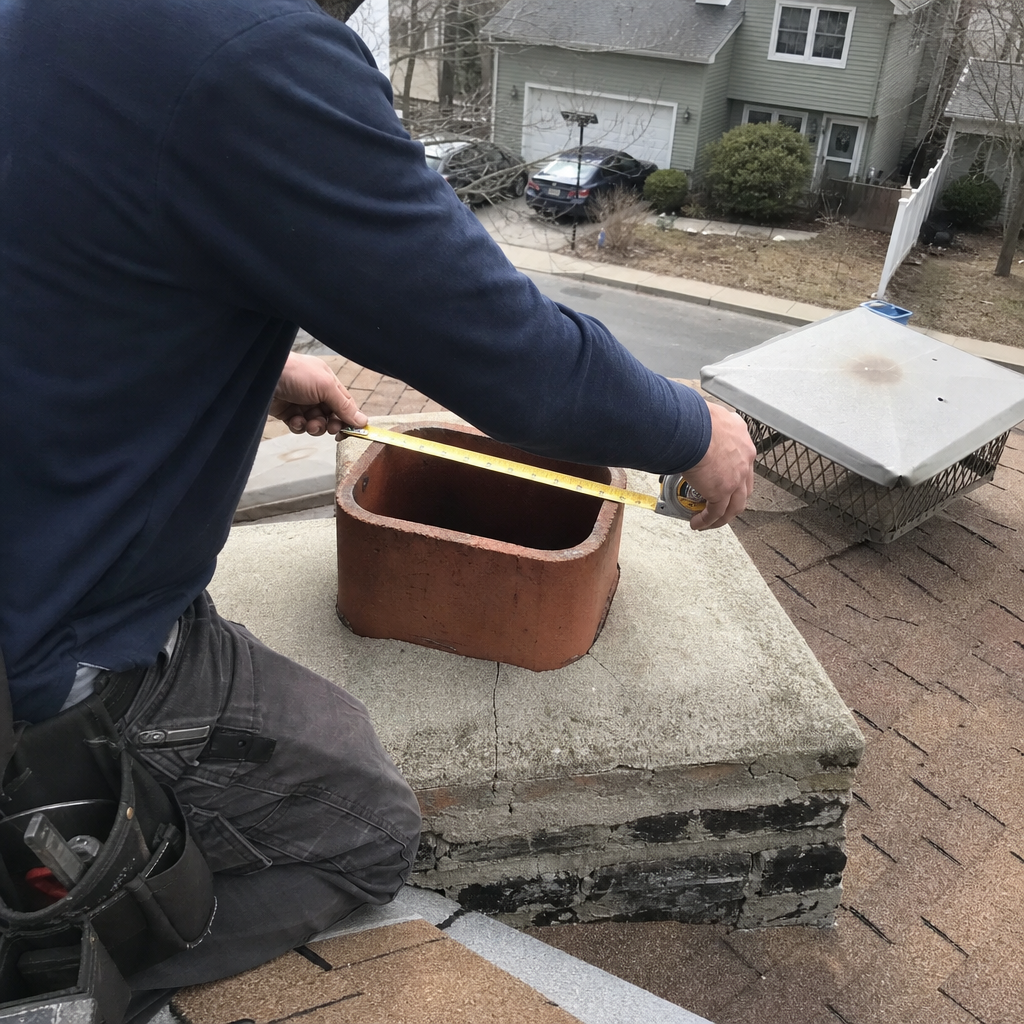
Robert handles every estimate himself, which means he carries a hammer, a probe, and a camera onto your roof — not a clipboard and a sales pitch. We’ve walked away from jobs where a coating was genuinely appropriate, and we’ve talked homeowners out of coatings when the underlying crown was too far gone to justify the expense. A chimney problem doesn’t get smaller by waiting — I’ve seen 17 years of proof.
Crown Problem or Flashing Problem? The Misdiagnosis That Costs You Double
Water in the firebox doesn’t automatically mean crown failure. In fact, one of the most expensive mistakes we correct is a flashing repair that was sold as a crown repair, or vice versa.
Last March, a homeowner in Throggs Neck called after another company quoted $1,600 for crown demolition and repour. Robert found surface-level crown crazing — condition 1, sealant-appropriate — but step flashing that had pulled away from the chimney shoulder after decades of thermal cycling. The water path was obvious once you traced the staining pattern: it ran down the exterior brick, entered at the flashing gap, and appeared in the firebox from the side, not the top. Crown repair would have done nothing. We reseated and reflashed the chimney for $780, sealed the crown surface as preventive maintenance, and the leak stopped that day.
The reverse happens too. We see flashing repairs sold to homeowners whose actual problem is crown failure with water tracking down the flue. The symptoms overlap — water in the firebox, efflorescence on exterior brick, damp odors — but the source and the fix are completely different. Owner-on-site diagnosis catches the right problem the first time because Robert’s climbing the ladder himself, not sending a salesperson with a tablet and a quota.
What a Code-Compliant Crown Looks Like — So You Can Evaluate Any Quote
Whether you hire us or not, you should know what you’re paying for. A properly proportioned Portland cement crown with a drip edge overhang meets these minimum specifications:
- Thickness: Minimum 2 inches at the edges, 2.5 to 3 inches at the center for positive drainage
- Slope: Minimum 3/8 inch per foot from center to edge, steeper in snow-load zones
- Drip edge: Overhang of at least 1 to 1.5 inches past the chimney face, with a groove or kerf to break water surface tension
- Material: Portland cement with air-entrainment additive for freeze-thaw resistance; we avoid pure mortar mixes that lack structural strength
- Reinforcement: Expanded metal lath or rebar in crowns exceeding 30 inches in any dimension
- Flue clearance: Minimum 2-inch gap between flue liner and crown material, filled with compressible sealant to allow thermal expansion
We source our crown materials through Olympia Chimney and Copperfield — the same professional-grade lines used by commercial masonry contractors. The difference isn’t the brand name; it’s that Robert mixes and places every pour to these specifications, not to what saves an hour of labor. We’ve torn off crowns in Scarsdale and Rego Park that were poured flat, too thin, or directly against the flue liner — all shortcuts that guaranteed premature failure.
For homeowners comparing multiple quotes, we recommend requesting a written specification sheet that includes thickness, slope ratio, and material type. Any contractor who won’t document this in advance is asking you to trust what you can’t verify.
Key Takeaways: Chimney Crown Repair Cost in Greater New York
- Most legitimate crown repairs in our market fall between $650 and $1,200; sealant-only jobs under $550 are uncommon in pre-1980 housing stock
- Greater New York’s coastal freeze-thaw cycle is uniquely destructive — more events per winter than inland northern cities
- The “crown coat” is a temporary cosmetic fix, not a structural repair; know which condition you’re actually in
- Crown problems and flashing problems share symptoms but require different solutions; misdiagnosis wastes money
- Owner-on-site inspection by a technician who actually climbs the roof eliminates the guesswork
FAQs
Chimney crown repair in Greater New York typically costs between $350 and $1,850, with most homeowners paying $650 to $1,200 for through-cracking repairs or structural resurfacing. Sealant-only applications for minor surface crazing start around $350, while full demolition and repour of a failed crown runs $1,400 to $1,850 or more depending on chimney size and access. Call (866) 884-9512 for an exact quote — estimates are free, and Robert handles every inspection personally.
Repair is cheaper when the crown retains structural integrity — surface crazing or limited through-cracking can be addressed for $350 to $1,200. Replacement becomes the only viable option once edges are undermined, chunks are missing, or water has saturated the brick beneath, at which point continued patching wastes money on temporary fixes. We evaluate this on every roof we climb in Greater New York, and we’ll tell you honestly which side of that line you’re on.
We perform crown repairs year-round in Greater New York, but full repours require daytime temperatures above 40°F for proper cement curing — which we typically get even in January during our frequent thaw cycles. Emergency sealant applications and temporary waterproofing can be done in colder conditions to stop active leaks until weather permits permanent repair. If you’re seeing water in your firebox this winter, call (866) 884-9512 and we’ll stabilize the situation now and schedule the permanent fix at the first viable window.
The location of water entry and staining pattern usually reveals the source: crown leaks typically produce water at the firebox center or rear, with staining on the interior flue walls, while flashing leaks show water at the firebox sides or front corners with exterior brick staining near the roofline. Robert verifies this on the roof with visual inspection and water testing — we’ve saved Greater New York homeowners hundreds of dollars by catching misdiagnoses before unnecessary work begins. If you’re unsure, an owner-led inspection is the fastest way to know for certain.
Get an Honest Crown Assessment From the Owner Who Does the Work
We’ve completed more than a thousand chimney projects across Greater New York over 17 years, and crown condition is the single most misrepresented item we see in competitor quotes. Robert Garcia, our owner and lead technician, inspects every crown personally — no dispatched sales crew, no subcontractor who won’t be there if something needs adjustment. We document what we find, explain which of the three conditions you’re dealing with, and price the repair that actually solves the problem. Call (866) 884-9512 today for a free, no-pressure estimate, or visit our Chimney Cap & Crown page to learn more about our full range of crown, cap, and chimney top services.
Written by Robert Garcia, Owner & Lead Technician at Apex Chimney Cleaning Greater New York, serving Greater New York, NY.